

The ghost mannequin versus flat lay question gets posed as if it is about budget. It is not. It is about what the garment needs to communicate at the moment the customer encounters it.
Both techniques are legitimate. Both have a place in a fashion brand’s asset mix. The mistake most teams make is defaulting to one or the other across an entire range without thinking about which serves the customer’s decision at each touchpoint.
This guide is a decision framework for fashion brand and creative leads scoping an e-commerce shoot. It assumes you know what each format looks like. The question we are answering is which one your launch actually needs, and where the line sits when you need both.
The wrong question, and the right one
The wrong question is “which is cheaper, ghost mannequin or flat lay?”
The right question is “what does the customer need to see to feel confident clicking add-to-bag?”
For a structured trench coat, the customer needs to see how the shoulder sits, how the lapel folds, how the belt cinches. That is a three-dimensional question. Ghost mannequin answers it. Flat lay flattens it.
For a graphic t-shirt with a strong print, the customer mostly needs to see the print clearly and read the placement on the chest. That is a two-dimensional question. Flat lay answers it. Ghost mannequin adds production cost without commensurate benefit.
The wider the garment range, the more likely the answer is “both, for different SKUs.”
What ghost mannequin does well
Ghost mannequin photography earns its place when garment shape is part of the buying decision.
It shows the three-dimensional fit of the piece without the distraction of a model. The customer sees how the collar sits, how the cuffs taper, how the back of the garment relates to the front. The shoulder line, the dart placement, the seam construction are all readable.
It standardises the form across an entire range. Every blazer photographed with the same internal form reads as belonging to the same collection. The customer can compare across the range without mental adjustment for different body shapes or model poses.
It signals premium. The customer’s brain registers the cost of doing ghost mannequin properly even if they cannot articulate it. Brands that invest in the technique tend to read as more considered than brands that flat lay everything.
What flat lay does well
Flat lay photography earns its place when the garment’s appeal is its surface rather than its form.
It captures pattern, print, and graphic detail more cleanly than any other format. A loud Hawaiian shirt, a slogan tee, a printed silk scarf, a striped knit, all read more strongly flat than on a form.
It works at scale. A flat lay setup with a good stylist can capture 80 to 120 garments in a day. Ghost mannequin is closer to 25 to 40 garments in the same time, sometimes fewer for tailored pieces. For high-volume catalogues, the scale economics matter.
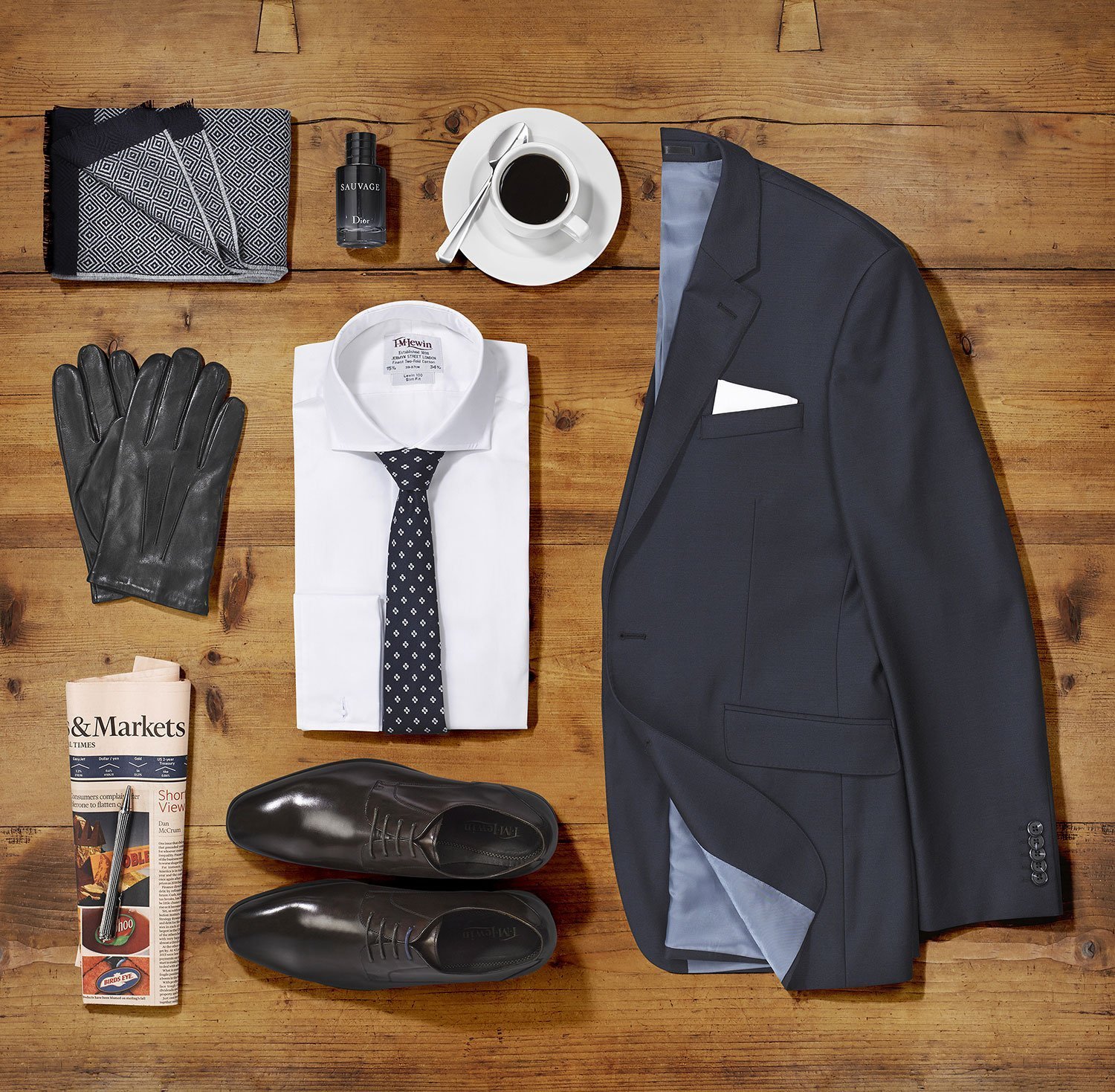
It works editorially. Knolling layouts, seasonal flat lay groupings, and styled flat lay compositions live well on social media, brand editorial, and lookbook openers. The format has a creative identity beyond pure e-commerce utility.
A four-quadrant decision framework
Most fashion launches fall into one of four quadrants. The right format choice follows the quadrant.
High structural integrity, low pattern interest. Tailored coats, blazers, structured jackets, knitwear with shape. Ghost mannequin wins. The customer needs to see the form.
Low structural integrity, high pattern interest. Graphic tees, printed silk, novelty knits, statement scarves. Flat lay wins. The customer needs to see the surface.
High structural integrity, high pattern interest. Printed dresses, patterned suiting, sculptural pieces with surface decoration. Both matter, and the answer is usually ghost mannequin as the hero with flat lay supporting it.
Low structural integrity, low pattern interest. Plain cotton basics, generic accessories, low-margin SKUs. Flat lay at speed, no ghost mannequin needed.
Most fashion ranges contain pieces from at least two of these quadrants. The asset matrix should specify which technique applies to which SKUs at the brief stage.
Where teams overspend on ghost mannequin (and underspend on flat lay)
Brands aiming for a premium positioning often default to ghost mannequin across the entire catalogue, regardless of the garment type. The cost lands invisibly. Production days take longer. Per-SKU costs rise. The flat lay-suitable pieces in the range are over-produced for no commercial gain.
The corrective is unglamorous: split the range by garment type at the brief stage. Hero pieces and structural garments get ghost mannequin. Pattern-led and basic pieces get flat lay. The total asset matrix delivers more, faster, for the same budget.
The reverse problem is rarer but real. Brands aiming for budget efficiency default to flat lay across the entire range, including pieces where the customer needs three-dimensional information. The cost lands in returns. A trench coat photographed flat looks shapeless, the customer guesses wrong about the fit, and the piece comes back. The returns rate eats the savings from the cheaper production.
How to brief both in a single production day
Most launches can capture both formats in one day if the planning is right.
The pattern that works:
Morning block for ghost mannequin work. The studio sets up the internal form and lighting state once, then captures every SKU in the range that needs ghost mannequin treatment in sequence. Holding the lighting and form constant produces collection consistency.
Mid-day block for flat lay. The studio adjusts to the flat lay setup, often a single overhead camera position with controlled lighting. SKUs flow through in groups by colour family or product type.
Afternoon block for any hero work that needs additional treatment. Hero pieces for the campaign, lifestyle context shots, detail macros.
The asset matrix sits at the front of the brief and specifies which technique each SKU uses. Without it, the order of the day is whatever the studio remembers. With it, the day produces both formats coherently.
A worked example: an outerwear and graphic-tee brand launch
A typical brief: a contemporary fashion brand launching a 24-SKU collection. The collection includes eight tailored outerwear pieces (coats, blazers, jackets), ten printed t-shirts and sweatshirts, and six accessories (scarves, bags, belts).
The format mix: ghost mannequin for the eight outerwear pieces (where the structure sells the garment). Flat lay for the ten printed pieces and the six accessories (where the surface sells the garment).
Single production day, structured: morning block for the outerwear in ghost mannequin, all eight captured under the same lighting state and the same internal form for consistency. Mid-day block for the printed pieces in flat lay, sequenced by colour family. Afternoon block for the accessories, with two flat lay setups (one for soft accessories, one for hard).
Delivery: 24 hero shots in the appropriate technique, plus retailer-specific exports, plus social cut-downs. The launch ships with the right format for the right piece, and the budget is allocated where it earns its return.
If you are scoping a fashion launch and want help deciding the format mix across the range, share the SKU list and we will tell you which pieces benefit from ghost mannequin and which work on flat lay. We work across fashion photography and e-commerce photography at the Bankside studio.
Share your brief. We will come back the same day.