

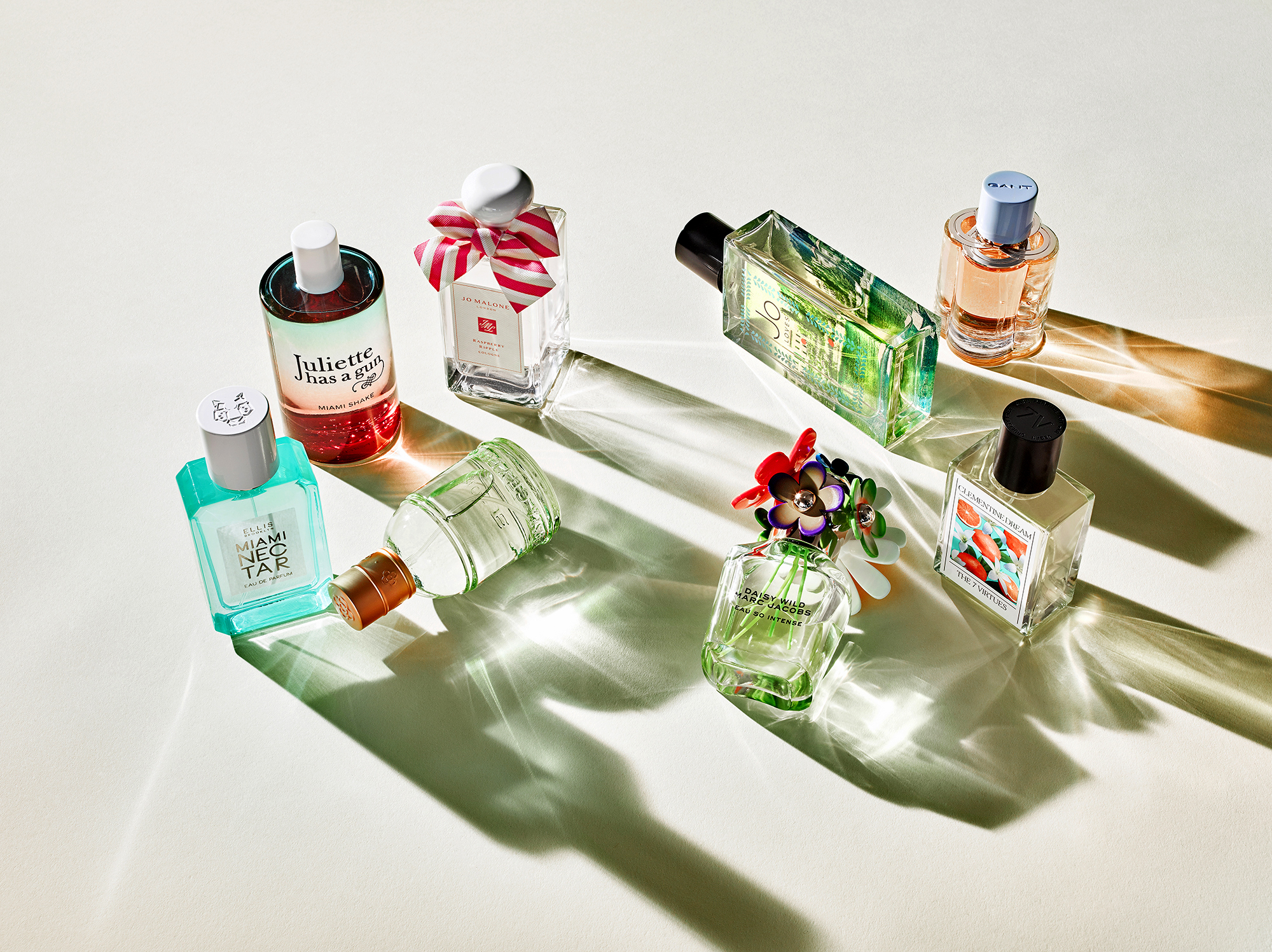
Liquids, foams, and translucent products are the hardest subjects in commercial photography.
A solid product sits on a set, holds its shape, and accepts the lighting the studio designs for it. A liquid behaves. A foam settles. A translucent product transmits light through itself in ways that opaque products do not. Each presents specific challenges that standard product photography does not face, and each rewards specialist craft that generalist studios often lack.
This guide is for beauty, drinks, skincare, and any brand whose commercial proposition involves capturing products that do not stay still. It is about what makes each subject technically demanding, what the production approach looks like, and what to brief differently.
Why liquids are different
A solid product is captured. A liquid is captured at a moment.
The pour is a moment. The bubble formation is a moment. The condensation is a moment. The surface tension on the meniscus is a moment. Each frame photographs a specific instant in a continuous process of behaviour.
This affects the production fundamentally.
The capture is one of many attempts. A pour shot is rarely the first frame. The team captures dozens of attempts at the same composition, selecting the strongest frame from the set.
The lighting has to work across the behaviour. A lighting setup that flatters a static composition may need adjustment for the liquid in motion.
The retouch is more involved. Liquid photography often requires composite work, surface clean-up, and behavioural refinement that opaque product work does not.
The sample provision is more generous. Each capture consumes product. Generous sample provision is part of the brief.
A specialist studio working on liquids has the calibrated setups, the capture technique, and the retouch capability to deliver clean liquid imagery. A generalist studio sometimes produces work that reads as staged or composite when the brand wanted it to read as captured.
The pour: technical demands
The pour is the most photographed liquid moment.
A drink pouring into a glass. A cream pouring into a hand. An oil pouring from a dropper. A foundation pouring from a bottle. Each pour has its own physical behaviour and its own commercial purpose.
The technical demands:
High-speed flash to freeze motion. Standard continuous lighting cannot capture pour detail. High-speed flash that synchronises with the camera shutter freezes the liquid mid-flow without motion blur.
Multiple captures of the same setup. The pour shape varies frame to frame. The team captures dozens of attempts at the same composition.
Reflective and refractive management. Liquids reflect and refract light through them. The lighting setup has to anticipate both behaviours.
Surface tension behaviour. The liquid’s surface tension creates specific visual signatures (droplet shapes, surface curves, edge behaviour). The lighting should reveal these honestly.
Container interaction. Where the liquid is pouring from or into a container, the interaction between liquid and container surface is part of the composition.
Cleanup between attempts. Sets get wet, surfaces need wiping, glasses need clearing. The production day has built-in time for cleanup between captures.
A specialist studio working on pour photography maintains the technical setup and the production workflow to handle the iteration efficiently.
Foams and bubbles
Foam and bubble photography presents its own challenges.
Foam stability. Most foams are short-lived. The captured image has to land within the foam’s stable window.
Bubble distribution. Bubble size, density, and pattern are part of the commercial signal. Lighting and composition should reveal the bubble structure without making it look chaotic.
Foam character variation. Whipped foam, beer head, soap lather, shampoo foam, cappuccino crema, each has distinctive character. The photography should respect the type.
Lighting through foam. Foam can be partially transparent or opaque depending on density. The lighting decisions should match.
Sample replenishment. Foams are usually one-shot subjects. Fresh foam for each take.
The temptation in foam photography is to use synthetic alternatives (whipping cream substitutes, foam props, photoshopped foam). These often read as fake. Real foam captured in its proper window reads as authentic.
Translucent and transparent products
Products that transmit light through themselves require specific lighting handling.
Glass packaging. Bottles, jars, vials. The glass is part of the photograph and the contents are visible through it.
Translucent product itself. Clear gels, transparent soaps, lacquers, light-coloured liquids. The product transmits light through itself.
Semi-translucent product. Pearlescent fluids, opalescent treatments, milky textures. Partial light transmission with surface character.
Stones and crystals in beauty packaging. Cut glass bottle elements, crystalline product packaging.
The lighting principles:
Back-lighting or rim-lighting reveals translucency. Light through the product brings forward the translucent character. Pure front-lighting flattens it.
Controlled environment reflection. Translucent products reflect the studio environment. The setup has to manage what reaches the surface.
Colour fidelity through transmission. The product’s colour as seen through itself or its packaging is part of the commercial proposition. Lighting that distorts the colour misrepresents the product.
Surface character preservation. Even highly translucent products have surface character (frost, gloss, texture) that the lighting should reveal alongside the transmitted light.
Composite work for ambitious compositions. Some translucent product compositions require combining captures (one for the product, one for the background visible through it, one for the surface character).
Beauty texture as a translucent challenge
Many beauty textures are translucent or semi-translucent.
Clear gel cleansers. Translucent serums. Pearlescent foundations. Milky moisturisers. Light-coloured treatments. Each combines liquid behaviour, translucency, and the texture photography demands of beauty work.
The production approach for these textures:
Calibrated lighting for the specific texture. The lighting setup is calibrated against a sample of the actual product. Lighting that flatters one texture may not suit another.
Hero composition that respects the texture’s commercial character. A serum’s drop, a cleanser’s lather, a moisturiser’s smear. The composition should communicate the texture’s intended use.
Macro work for surface character. Close-in detail revealing the texture’s surface, particles, or fluid structure.
Application context where appropriate. The texture on skin, on a surface, in use. The application context extends the commercial story.
A specialist beauty studio working on texture maintains calibrated setups for the different texture categories. A generalist studio sometimes applies generic lighting that misses the texture-specific commercial signals.
Drinks-specific translucency
Drinks photography combines liquid behaviour and translucency in specific ways.
Wine. The liquid colour visible through the bottle and through the wine glass. The glass shape, the liquid colour, the surface meniscus all interact.
Spirits. The bottle glass colour, the spirit colour, the dilution effects with ice or mixer. Each interacts in the photographed composition.
Cocktails. The colour layering in built cocktails. The garnish interaction. The ice and dilution.
Coffee and tea. The colour, the crema or foam, the surface reflection.
Soft drinks and mixers. The carbonation, the colour, the surface bubbles.
Each requires the studio to consider the liquid colour, the container behaviour, and the lighting environment as a single integrated system.
Production approach for difficult subjects
The production day for liquid, foam, and translucent product work:
Generous setup time. The lighting calibration for these subjects takes longer than for standard product work. Plan for 30 to 60 minutes per setup rather than the standard 15 to 30.
Capture iteration time per shot. Each composition involves multiple capture attempts. Plan for 30 to 90 minutes per hero composition rather than 15 to 30 for standard product work.
Cleanup and reset time between shots. Wet sets, replenished samples, restored composition state. Build cleanup into the day’s plan.
Sample replenishment generously. Each shot consumes product. The brief should anticipate generous sample provision.
Specialist retouch time. Liquid and translucent work often involves significant retouch. The post-production timeline accommodates this.
Specific team requirements. Often involves a food and drink specialist, an assistant focused on the practical fluid management, and sometimes a hand model for application shots.
The production cost per asset for these subjects is typically higher than for standard product work. The investment is justified by the commercial value of the work that only specialist studios can deliver.
Briefing notes for difficult-subject shoots
The strongest briefs we receive for liquid, foam, and translucent product photography:
The product list with the specific behaviours to capture (pours, foam formation, surface texture). The container or packaging context. The reference imagery from the brand’s existing work or aspirational references. The asset matrix with hero compositions, supporting angles, and macro details specified. Sample provision generously sized. Production logistics including any cleanup or replenishment considerations.
What does not need to be in the brief: detailed lighting instructions or attempts to specify the technical setup. Those are the studio’s decisions.
If you are commissioning photography for liquid, foam, or translucent product work in London, share the product and the behaviour you want captured and we will plan the production around the technical demands. We work across beauty photography, drinks photography, perfume photography, and beauty textures at the Bankside studio.
Share your brief. We will come back the same day.