

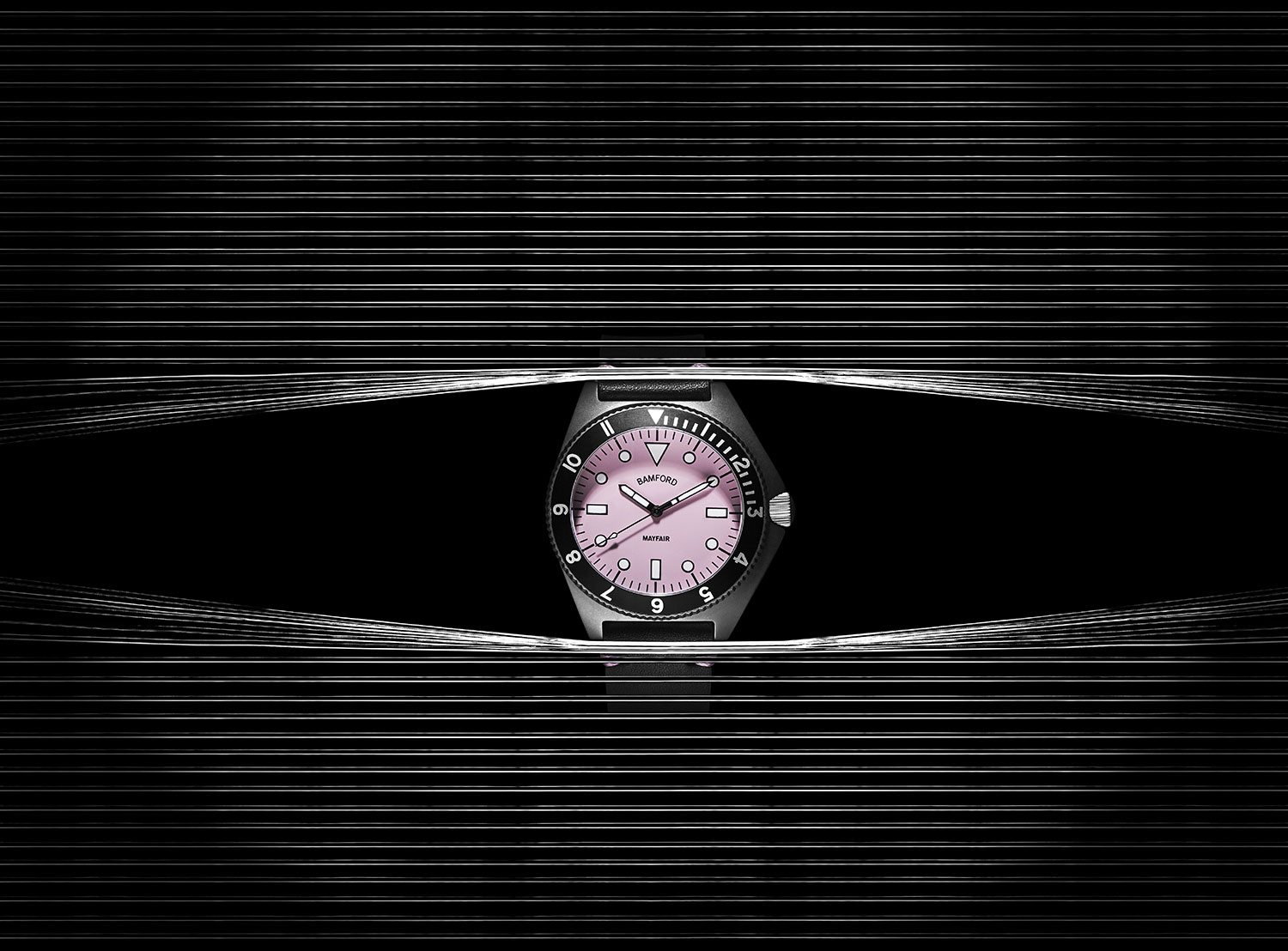
Watch e-commerce has matured into a specific discipline that differs from general product e-commerce.
The customer evaluating a £3,000 watch online is not making the same kind of decision as the customer evaluating a £30 accessory. The asset matrix has to support a higher level of scrutiny, a longer consideration window, and a more sophisticated buyer than general e-commerce conventions assume.
This guide is for watch brands, retailers, and online platforms scoping e-commerce photography in London. It is about what watch PDPs actually need, how the carousel and social asset structure should support the buying decision, and what to brief differently from general product e-commerce.
The watch e-commerce buying decision
A watch buyer online is doing more work than a typical e-commerce buyer.
They are reading the PDP carefully. They are zooming into the images at high resolution. They are comparing the listing across multiple retailers. They are sometimes researching the specific reference in collector forums and dedicated watch media. They are evaluating the brand’s claims against the photography’s evidence.
The PDP has to support this scrutiny. Imagery that satisfies a general e-commerce buyer often fails the watch buyer’s deeper investigation. The asset matrix has to anticipate the watch-specific buying process.
The principles that hold:
More angles than general products require. Five to ten angles per watch is the practical baseline. Hero, three-quarter, side profile, back (caseback), top-down, crown detail, bracelet detail, clasp detail.
More macros than general products require. Dial close-up, applied indices, hands at close range, bezel detail, case-side detail.
Movement-side coverage where the watch has a display caseback. The movement is often the deciding factor for collectors.
Wristshot context. Scale and lifestyle context that pure product photography cannot provide.
Specific feature detail. Whatever the brand markets as the watch’s distinguishing feature (a specific complication, a heritage element, a material treatment) deserves dedicated coverage.
A watch PDP that ships with three images is significantly underdelivering for the audience.
The PDP carousel structure
The strongest watch PDP carousels follow a predictable structure.
Image 1: Hero composition. The watch in its standard presentation position. Often three-quarter angle, clean background, calibrated lighting. The image the customer arrives on.
Image 2: Wristshot or in-context. The watch on a wrist or in lifestyle context. Provides scale and emotional positioning.
Image 3: Side profile. Showing the case depth, bracelet articulation, and crown position. Reveals proportions the front-on cannot show.
Image 4: Dial macro. Close-in detail of the dial showing applied indices, hand finishing, and dial texture.
Image 5: Case-back or movement. For display-back pieces, the movement. For solid-back pieces, the engraving and brand identity.
Image 6: Bracelet or strap detail. Close-in shot of the bracelet articulation, clasp mechanism, or strap material.
Image 7: Crown or pusher detail. For chronographs and pieces with notable hardware, the crown and pusher detail.
Image 8: Box and papers composition. Particularly for pre-owned and full-set listings, the accompanying materials.
Image 9 to 10: Additional angles, lifestyle, or feature-specific imagery. Filling out the carousel for premium pieces.
This sequence builds the customer’s confidence systematically. Brands skipping or reordering the sequence often lose conversion at the points where customers expected information they did not find.
Social asset structure for watch brands
Watch social media has its own conventions distinct from PDP imagery.
Square hero compositions. Instagram feed and TikTok content default to square or vertical. Watch brands shooting only horizontal hero imagery struggle to maintain visual consistency in social feeds.
Wristshots as primary social content. Wristshots perform better than pure product shots in social feeds. The lifestyle association is part of why watch content engages.
Detail close-ups that work without context. Dial macros, movement details, bracelet articulation. Social viewers stop on visual interest; close-in detail content stops the scroll.
Video and motion content. Short videos showing the watch in motion (rotor turning, hands sweeping, complication engaging) perform well across platforms.
Behind-the-scenes content. Studio shots, watchmaker imagery, brand process content. Adds authenticity to the brand’s social presence.
Lifestyle context that extends the brand world. The watch in environments and contexts that suggest the brand’s positioning.
Collaboration and limited-edition launch content. Particularly for limited editions, social is often the primary launch channel.
A watch brand’s asset matrix should specify social content as its own category rather than expecting derivatives from PDP work to perform on social.
The production approach for combined e-commerce coverage
Combining PDP, carousel, and social into a single coordinated production:
Asset matrix at the brief stage. Every required output across PDP, social, lifestyle, and marketing listed in advance.
Block-structured day. Morning block for the PDP product photography (angles, macros, details). Mid-day block for wristshots and lifestyle. Afternoon block for social-specific compositions and any motion content.
Capture-by-angle methodology for multi-piece launches. Where multiple watches are being photographed, capture all pieces at the hero angle first, then all at secondary angles, then all at detail level. The lighting state stays locked for each angle block.
Retoucher master direction across all formats. PDP, wristshot, lifestyle, and social content all retouched to consistent standards.
Delivery structured by use. Separate folders for PDP, wristshot, lifestyle, social, and any marketing-specific assets.
This is more demanding planning than a single-purpose shoot but significantly more efficient than commissioning the formats as separate productions.
Retailer-specific watch photography
Watch brands selling through multi-brand retailers (online retailers like Watchfinder, Bob’s Watches, Crown & Caliber, or platform retailers like Mr Porter, Chrono24) face additional photography requirements.
Platform-specific image specifications. Each retailer typically has its own dimension, background, and composition requirements.
Brand-specific guidelines that the retailer enforces. Where the brand has authorised dealer guidelines, the retailer often applies them.
Carousel composition that fits the retailer’s UI. Carousel image count, ordering conventions, and image relationship to product information vary by retailer.
Asset metadata for retailer systems. Image file names, metadata fields, and tagging conventions that match the retailer’s catalogue system.
A specialist studio working with watch retailers builds knowledge of each platform’s specific requirements. A brand commissioning a shoot that will serve multiple retailers should brief these requirements explicitly.
The pre-owned watch e-commerce specifics
The pre-owned market has additional photography requirements beyond new watch work.
Condition documentation. Pre-owned listings require condition imagery that supports the listing’s condition claims.
Patina honesty. Where the piece has age-appropriate patina, the photography should respect it rather than retouch it away.
Full-set imagery. Box, papers, accessories. Pre-owned full sets command premiums; the imagery supports the premium.
Provenance visibility. Where the piece has ownership history, authentication documentation, or service records, the imagery should make this visible.
Reference-specific knowledge in the listing imagery. Pre-owned buyers often know the reference well. The photography should show the specific dial variant, the specific case-back markings, the specific bracelet end-link configuration that the listing claims.
A specialist studio working with pre-owned dealers maintains the reference knowledge that supports accurate listing imagery. A studio unfamiliar with the pre-owned market sometimes captures pieces in ways that miss the specific commercial signals.
Asset matrix for a watch e-commerce launch
A typical asset matrix for a watch e-commerce launch:
Per-watch PDP coverage. Hero, three to seven angles, three to five macros, plus wristshot. Twelve to fifteen images per watch.
Brand lifestyle content. Five to ten lifestyle compositions per brand or per collection. Used across the homepage, the brand pages, and the social channels.
Social-specific content. Two to three watches per launch receiving dedicated social-format capture (square, vertical, motion). Three to six assets per watch.
Marketing and promotional content. Two to four hero compositions per launch suitable for paid campaigns, email marketing, and brand storytelling.
Press distribution package. Three to five editorial-register heroes plus four to six detail captures per launch. Press-resolution exports.
For a launch of four to eight watches, the total deliverable count typically lands at 100 to 200 assets. A well-planned production day or two-day production can deliver this.
Briefing notes for watch e-commerce shoots
The strongest briefs we receive for watch e-commerce work:
The piece list with references and any variant or strap options. The asset matrix per piece across PDP, lifestyle, social, marketing, and press use. The retailer mix and any retailer-specific requirements. The brand’s existing visual register references. Sample handling logistics including transit, insurance, and any custodian requirements.
What does not need to be in the brief: lighting instructions or attempts to specify the production technically. Those are the studio’s decisions.
If you are scoping watch e-commerce photography in London for a brand, retailer, or marketplace listing, share the piece list and the channel mix and we will plan the production around the commercial use. We work across watch photography, e-commerce photography, and watch photography London at the Bankside studio.
Share your brief. We will come back the same day.